20–30 hrs
Half-Life
mTOR / PI3K
Pathway
Post-Workout
Timing
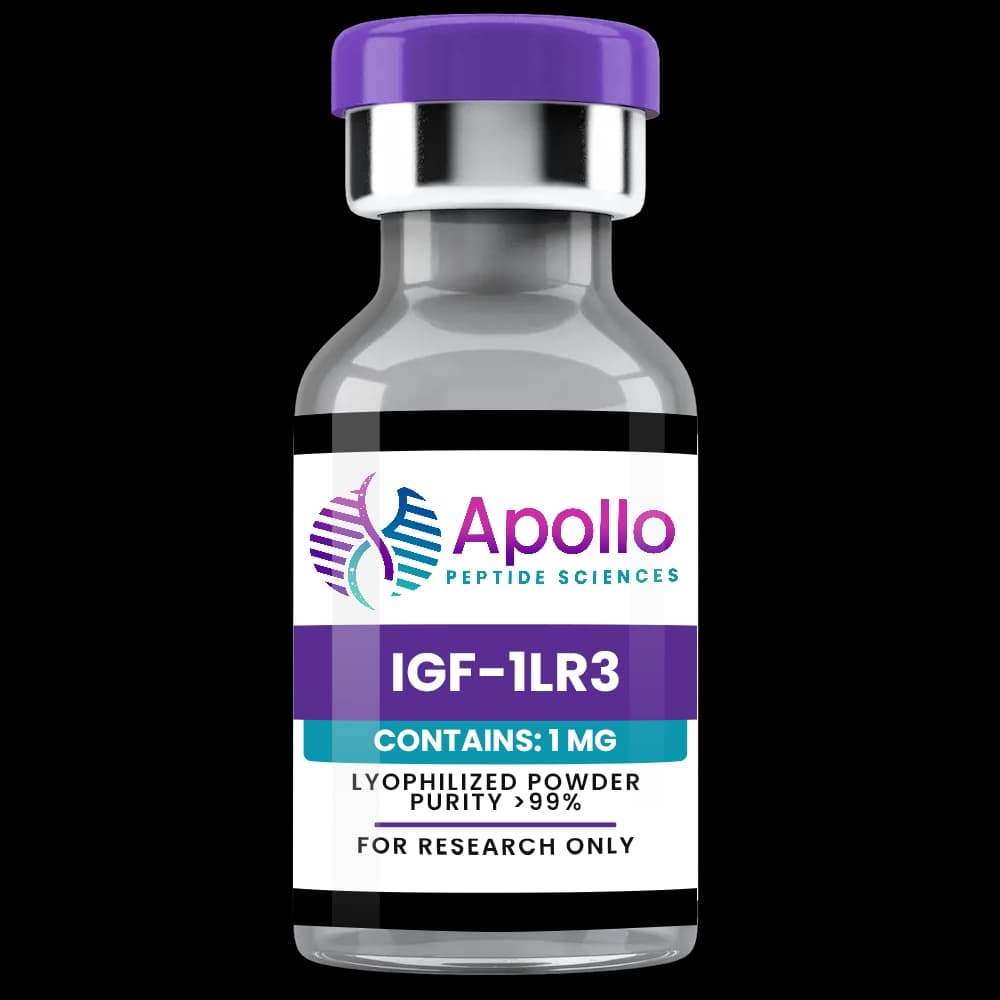
IGF-1 LR3
Direct Anabolic Signal
Long-acting IGF-1 analogue that directly activates muscle hypertrophy pathways. The most anabolic peptide available — promotes lean mass growth and visceral fat reduction.
Suggested Protocol
20–50mcg SubQ or IM, administered post-workout when muscle cells are maximally insulin-sensitive and IGF-1 receptor-upregulated. Short cycles recommended: 4–6 weeks on, 4–6 weeks off to maintain receptor sensitivity. Not suitable for continuous long-term use.
The Most Direct Anabolic Signal You Can Deliver to a Muscle Cell
IGF-1 LR3 — Long Arg3-Insulin-like Growth Factor-1 — is the most directly anabolic peptide available in research applications. Where growth hormone peptides like CJC-1295/Ipamorelin work upstream by stimulating GH production (which then drives IGF-1), IGF-1 LR3 delivers the anabolic signal directly to muscle tissue, bypassing the entire GH axis.
The "LR3" designation refers to key structural modifications that distinguish it from native IGF-1: an arginine substitution at position 3 and an extended 13 amino acid N-terminal sequence. These modifications dramatically reduce binding to IGF-binding proteins — the proteins that sequester and limit native IGF-1's activity. The result is a bioactive half-life of 20–30 hours (vs. minutes for native IGF-1) and a systemic distribution that reaches muscle cells throughout the body rather than acting only locally.
At the cellular level, IGF-1 LR3 binds the IGF-1 receptor on muscle cells, activating the PI3K/Akt/mTOR signaling cascade — the primary molecular pathway driving both muscle hypertrophy (growth of existing fibers) and hyperplasia (formation of new fibers). This dual mechanism of action is why IGF-1 LR3 produces muscle density and fullness that GH peptides alone cannot achieve — it acts at the terminal effector level of the GH/IGF-1 axis.
Stacked with CJC-1295/Ipamorelin, IGF-1 LR3 creates a comprehensive anabolic environment: elevated GH drives endogenous IGF-1 production throughout the day, while direct IGF-1 LR3 delivers a concentrated anabolic signal post-workout.
Bypassing the GH Axis
Why Acting at the Terminal Effector Level Changes Everything About the Result
Growth hormone peptides like CJC-1295/Ipamorelin work upstream: they stimulate the pituitary to release GH, which then travels to the liver to produce IGF-1, which then signals muscles to grow. IGF-1 LR3 skips every step in that chain. It delivers the anabolic signal directly to muscle tissue — the same signal the body produces at the end of that long pathway, but without the lag, without the signal loss at each conversion step, and without dependence on pituitary function or liver IGF-1 production. The result is a more direct, more concentrated anabolic stimulus than any upstream compound can produce.
The LR3 Modification
How Three Structural Changes Gave This Molecule a 30-Hour Half-Life
Native IGF-1 has a half-life measured in minutes — it's immediately bound by IGF-binding proteins (IGFBPs) that sequester it and limit its activity. IGF-1 LR3's modifications change this completely: an arginine substitution at position 3 reduces IGFBP binding affinity by roughly 1000-fold, and an extended 13 amino acid N-terminal sequence provides additional steric interference with binding protein attachment. The result is a modified molecule with a 20–30 hour half-life that circulates freely, reaches all muscle groups systemically, and activates mTOR and protein synthesis at every delivery point — not just near the injection site.
Timing and the Post-Workout Window
Why the Hour After Training Is the Only Rational Time to Use IGF-1 LR3
Post-workout, muscle cells are in a uniquely receptive state: insulin sensitivity is elevated (improving glucose and amino acid uptake), IGF-1 receptor expression is upregulated by the mechanical stress of training, and protein synthesis machinery is primed for activation. Injecting IGF-1 LR3 into this window means the anabolic signal arrives when the receiving cells are most capable of responding to it. Pre-workout or fasted dosing wastes much of the compound's potential — the receptors aren't upregulated and the cellular environment isn't optimized for the growth signal being delivered.
Key Benefits
Directly activates mTOR and muscle protein synthesis pathways
Extended 20–30 hour half-life provides sustained anabolic signaling
Reduces visceral fat via IGF-1 receptor activation in adipose tissue
Promotes both muscle hypertrophy (fiber growth) and hyperplasia (new fiber formation)
Bypasses GH axis — works independently of endogenous GH levels
Systemic distribution reaches all muscle groups from a single injection
Significantly amplifies results when stacked with CJC-1295/Ipamorelin
Improves nitrogen retention and amino acid uptake in muscle cells
Full Protocol
20–50mcg SubQ or IM, administered post-workout when muscle cells are maximally insulin-sensitive and IGF-1 receptor-upregulated. Short cycles recommended: 4–6 weeks on, 4–6 weeks off to maintain receptor sensitivity. Not suitable for continuous long-term use.
Best Stacked With